Track what matters
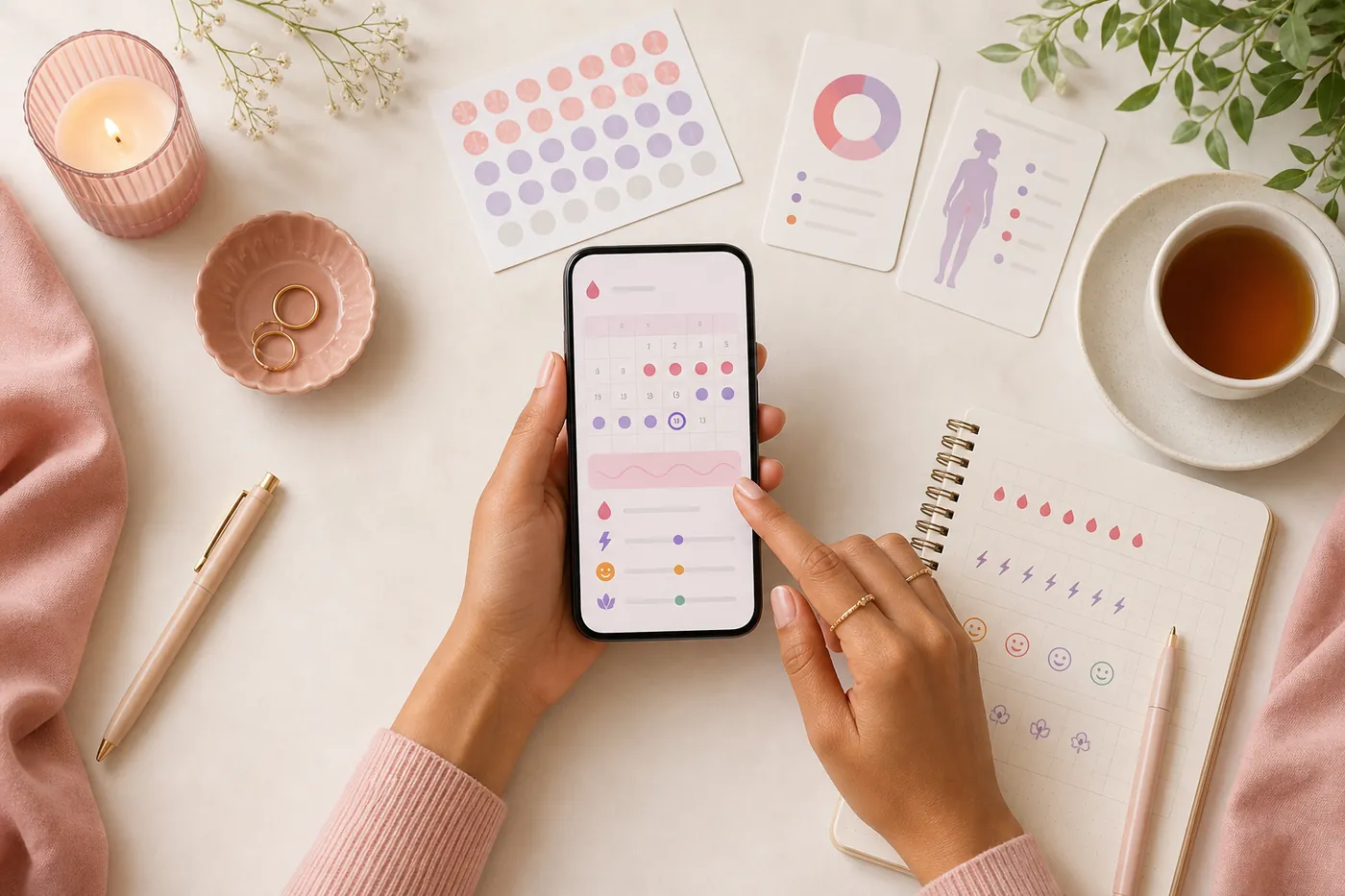
Log start dates, period duration, flow level, cramps, PMS, mood, energy, discharge, spotting, and cycle notes in a way that supports useful monthly insights.

Clora Care Guide
Cycle tracking helps you see patterns that are easy to miss day by day. Clora brings period dates, symptoms, ovulation signals, fertility windows, mood changes, and reminders into one connected view.

Log start dates, period duration, flow level, cramps, PMS, mood, energy, discharge, spotting, and cycle notes in a way that supports useful monthly insights.
Cycle predictions can help you prepare for expected periods, ovulation, hormonal changes, and wellness routines while remembering that predictions are not medical guarantees.
When you consult a doctor, your cycle history can make conversations around irregular periods, fertility, pregnancy planning, PCOS, and hormonal health more productive.
Cycle tracking means recording when your period starts and ends, along with the symptoms that come with it, so that the pattern of your menstrual cycle becomes visible over time. A single month tells you very little. Three or four months of records tell you your usual cycle length, how much it varies, roughly when you ovulate, which symptoms cluster in which week, and — most importantly — what counts as normal for you, so that a real change stands out instead of getting explained away.
You can do it on paper, in a notes app, or in a period-tracking app that does the arithmetic for you. The method matters far less than logging consistently.
Almost every tracking mistake comes from counting the days wrong, so it is worth getting this part right before anything else.
After three cycles you can work out your average length and your range — for example "29 to 33 days". That range is the useful output. A cycle outside it is worth noticing; a cycle inside it is just normal variation.
Tracking becomes far more useful once you understand what's actually happening across the month, rather than just marking a start date. A cycle has four phases:
Cycle length is counted from the first day of one period to the first day of the next, and 21 to 35 days is considered typical.
The simplest method: logging start and end dates over a few months to see your average cycle length and predict future periods. It's a good baseline but doesn't tell you exactly when you ovulate.
Your resting body temperature rises slightly right after ovulation. Taking your temperature at the same time every morning, before getting out of bed, and charting it over time can reveal your ovulation pattern retrospectively.
These urine test strips detect the surge in luteinizing hormone (LH) that happens 24 to 36 hours before ovulation, making them useful for predicting ovulation in advance rather than confirming it after the fact.
Cervical mucus typically becomes clearer, wetter, and more stretchy near ovulation. Combined with symptoms like mild pelvic twinges, breast tenderness, or a shift in libido, this can add another layer of insight when used alongside other methods.
Cycle-tracking apps use your logged history to estimate your next period and fertile window — but an estimate is exactly that. Stress, illness, travel, medication, sudden weight changes, and conditions like PCOD/PCOS or perimenopause can all shift timing in ways no algorithm can foresee. Predictions tend to get more accurate the more consistently you log, but they should never be treated as a guarantee, especially if you're relying on tracking for contraception.
When tracking reveals something worth discussing with a doctor
A gynecologist visit is worth considering if your cycle length is consistently under 21 or over 35 days, if cycles vary wildly from month to month, if you notice bleeding between periods, or if you're trying to conceive and want a clearer picture of your fertile window.
Most period apps are built around an assumption that does not hold for everyone: that you ovulate at a predictable point each month. If your cycles are irregular — which is common with PCOD/PCOS, thyroid disorders, perimenopause, and in the first couple of years after periods begin — calendar predictions will keep being wrong, and that is not a failure of your tracking.
What changes is what you track for. Instead of chasing a prediction date, use tracking to build evidence:
Six months of honest records showing that you bled four times, at intervals of 44, 61, 38 and 52 days, is far more useful in a ten-minute consultation than saying "my periods are all over the place".
You do not have to log everything every day. Different things are worth noticing at different points in the cycle:
These are not the same task, and the difference matters. When you are trying to conceive, the cost of a wrong guess is a missed month. When you are trying to avoid pregnancy, the cost of a wrong guess is very different — so the two need different levels of rigour.
To conceive: sperm survive for up to about five days, and the egg for roughly 12 to 24 hours after release, so the fertile window spans several days ending just after ovulation. Regular intercourse every two to three days across the middle of your cycle covers it without precision timing. Ovulation predictor kits, which detect the LH surge a day or so before ovulation, help if your cycles are long or irregular. Most couples under 35 with no known issues conceive within a year; see a doctor sooner if you are over 35, have irregular cycles, or have a known condition such as PCOS or endometriosis.
To avoid pregnancy: app-based calendar predictions are not contraception. Fertility awareness methods can work, but only the structured ones — symptothermal methods combining daily temperature and cervical mucus observation, taught properly and followed strictly every single day. Typical-use failure rates are considerably higher than for hormonal contraception, IUDs or condoms. If pregnancy would be a serious problem for you right now, discuss a method with a doctor rather than relying on a prediction screen.
Cycle data is among the most sensitive health information there is, and it is reasonable to ask where yours goes. Before committing to any tracker, it is worth checking a few things: whether the app states plainly that it does not sell or share your data with advertisers, whether data is transmitted and stored encrypted, whether you can export your records, and whether you can permanently delete your account and everything in it.
Clora stores your health data for your use, does not sell it, and lets you request deletion of your account and data at any time. You can read the specifics in our privacy policy and request removal through the account deletion page. Whichever app you choose, look for the same clarity — vagueness on these points is itself an answer.
How Clora Helps
Clora combines health tracking, AI-powered conversations with Clo, gynecology teleconsultation readiness, lab test context, medicine support, and personalized wellness insights in one women's health ecosystem.
Questions
The cycle has four phases: menstrual (bleeding), follicular (the egg matures), ovulation (the egg is released), and luteal (the days before the next period). Their lengths vary, but ovulation typically happens about 14 days before the next period starts.
No single method is perfect. Combining calendar tracking with basal body temperature and/or ovulation predictor kits (which detect the LH hormone surge) gives a more reliable picture than any one method alone.
Predictions are estimates based on your past cycle history. Stress, illness, travel, medication, weight changes, and conditions like PCOS or perimenopause can all shift ovulation and period timing in ways no app can foresee.
Most people start seeing a meaningful pattern after 3 to 4 cycles of consistent tracking, though it can take longer if your cycles are naturally irregular.
Fertility awareness methods based on tracking can reduce pregnancy chances when practiced carefully and consistently, but they are less reliable than most other contraception methods and require guidance from a doctor to use safely.
Flow intensity, pain level, mood, sleep, discharge changes, and any new or unusual symptoms all add useful context beyond just start and end dates.
Day 1 is the first day of proper bleeding, not spotting or brownish discharge. Your cycle length is the number of days from Day 1 of one period up to the day before your next period begins. Counting from the end of a period instead of the start is the most common tracking mistake.
Stop relying on predicted dates and track evidence instead: log every bleed with its date and whether it was spotting or a full period, count how many periods you have in a year, and watch for ovulation signs such as egg-white cervical mucus rather than expecting a fixed day. Fewer than eight periods a year, or cycles regularly over 35 days, is worth discussing with a gynecologist.
App-based calendar predictions are not contraception. Structured fertility awareness methods that combine daily basal body temperature with cervical mucus observation can work, but they must be taught properly and followed strictly, and their typical-use failure rates are considerably higher than hormonal contraception, IUDs or condoms. Talk to a doctor before relying on tracking to avoid pregnancy.
The fertile window covers the several days before ovulation plus the day after, because sperm can survive up to about five days while the egg lasts 12 to 24 hours. Intercourse every two to three days through the middle of your cycle covers the window without precise timing. Ovulation predictor kits help if your cycles are long or irregular.
That depends on the app. Look for a clear statement that your data is not sold or shared with advertisers, encrypted storage and transmission, the ability to export your records, and a way to permanently delete your account and data. Clora does not sell your health data and lets you request deletion at any time — see our privacy policy.
No. Menstrual cycles can change due to stress, illness, medication, travel, pregnancy, PCOS, menopause, and other factors.